
QPP Collection Types Explained: How to Choose the Right One for Your MIPS Score
Every year, MIPS-eligible clinicians spend significant energy choosing which quality measures to report, and almost no energy thinking about how they report them. That is a mistake that quietly costs points.
The One Decision That Changes How Many Points Your Measures Are Worth
Collection type is not a checkbox. It determines which benchmark pool your performance lands in, whether your measure is capped at 7 points before you even start, and how much room you have to differentiate your score.
Two practices reporting the identical clinical measure can earn completely different scores — not because one performs better, but because they chose different collection types.
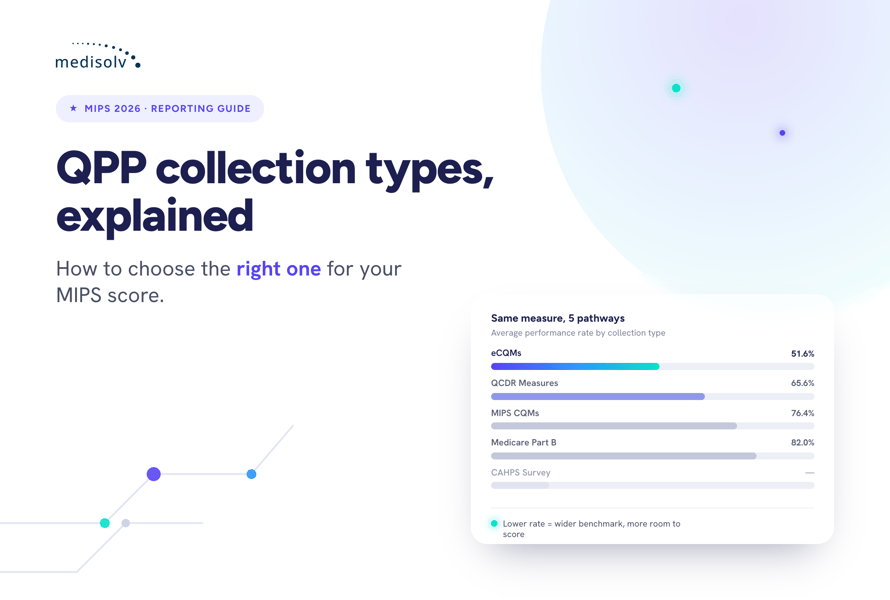
As of 2026, there are five collection types available under MIPS. Here is what each one means for your score.
Key concept: A benchmark is not just a comparison. It is your scoring ceiling and floor. The collection type you choose determines which benchmark pool your performance lands in. Same measure, different pool, different points.
The Five Collection Types at a Glance
| Collection Type | How It Works | # Measures | Avg. Performance Rate | 7-Pt Cap Risk | Who Can Use It |
|---|---|---|---|---|---|
| eCQMs | Report from certified EHR (CEHRT required) | 49 | 51.6% | Low — 4% capped | All practice sizes |
| MIPS CQMs | Submitted via QCDR, qualified registry, or self-submission | 162 | 76.4% | High — 27% capped | All practice sizes |
| QCDR Measures | Specialty-developed measures via CMS-approved QCDR | 200 | 65.6% | Very Low — 3% capped | All practice sizes |
| Medicare Part B Claims | Flows from routine Medicare billing — no separate submission | 25 | 82.0% | Moderate — 24% capped | Small practices only (≤15 clinicians) |
| CAHPS for MIPS Survey | Vendor-administered patient survey; scores as a high-priority measure | 9 SSMs | Benchmarked from 2024 data | N/A | Groups, virtual groups, APM Entities |
1. eCQMs
High ceiling. Wider benchmarks. Your EHR does the heavy lifting.
If you have certified EHR technology and strong data capture workflows, eCQMs may be the highest-scoring collection type available to you.
Here is why: the overall number of eCQM reporters is smaller and less saturated than MIPS CQMs. That translates directly into lower average performance rates and wider benchmark distributions, which means your strong performance has more room to climb into the higher deciles.
Across the 18 quality measures available as both eCQMs and MIPS CQMs in 2026, 14 show a lower average performance rate through the eCQM collection type. A lower average is not a bad sign. It is a scoring opportunity.
| QualityID 317 — High Blood Pressure Screening & Follow-Up | Average Performance Rate |
|---|---|
| eCQM | 28.1% |
| MIPS CQM | 73.5% |
| Medicare Part B Claims | 87.2% |
Same measure. Same clinical work. Very different benchmarks.
A practice performing at 70% on the high blood pressure measure above likely lands in the upper deciles as an eCQM reporter, and in the mid-range as a MIPS CQM reporter. Same work. Different points.
The topped-out picture tells the same story. Only 2 of 49 eCQM entries in the 2026 benchmark file carry the 7-point scoring cap, compared to 44 of 162 MIPS CQM entries. If you are currently capped on a MIPS CQM, check whether that same measure is available as an eCQM. Odds are it is not capped there.
Best fit for: Technology-forward practices with clean EHR data capture, solid data completeness rates, and measures that overlap with the eCQM inventory.
2. MIPS CQMs
The most widely used. Also the most capped.
MIPS CQMs are the backbone of QPP quality reporting — 162 measures with established benchmarks, broad clinical coverage, and the most mature reporting infrastructure in the program. If you work with a QCDR or qualified registry, there is a good chance this is how you are already reporting.
But the very maturity that makes MIPS CQMs familiar is also what makes them strategically risky for high performers.
The topped-out problem is real. Of the 162 available MIPS CQMs:
- 70 are identified as topped out (43%)
- 44 carry the 7-point scoring cap (27%)
If your practice is performing at 90% or above on a MIPS CQM with a 7-point cap, you are earning the same score as a practice at 75%. There is no reward for the gap, and you cannot earn it back within that collection type.
A measure is capped at 7 points when it has been topped out through the same collection type for two consecutive years. The cap applies in the second year.
The average performance rate across scored MIPS CQMs is 76.4%, the highest of any clinician-submitted collection type. That reflects the natural tendency to report measures where you already perform well. Rational individually. Collectively, it compresses the benchmark and limits how much strong performance can differentiate.
Best fit for: Practices with broad clinical needs and existing registry relationships, as long as you have audited for topped-out caps on your current measure set.
3. QCDR Measures
200 measures. Built for the specialists MIPS forgot.
The standard MIPS inventory was not designed with anesthesiologists, pathologists, or radiation oncologists in mind. QCDR measures were. Qualified Clinical Data Registries are CMS-approved entities that develop and track their own specialty-specific quality measures, and in 2026, there are 200 QCDR measures available. That is more than any other collection type.
The topped-out cap rate for QCDR measures is just 3%, compared to 27% for MIPS CQMs. The average performance rate is 65.6%, meaning wider benchmark distributions and more room to differentiate.
For specialties struggling to find clinically relevant measures in the standard inventory, QCDR measures are not just an alternative. They are often the better option.
QCDR measures are also a strong fit for clinicians subject to the defined topped-out measure benchmark methodology. Specialties with limited measure choice — including gastroenterology, radiation oncology, and others — can avoid the 7-point cap on certain topped-out MIPS CQMs through this pathway.
The trade-off: you cannot report QCDR measures independently. You must work with the QCDR that owns the measure, which means a vendor relationship, data-sharing agreements, and submission fees. QCDRs are approved annually by CMS; confirm your chosen QCDR is on the current approved list before you start collecting data.
Best fit for: Specialty practices that cannot find 4 to 6 clinically meaningful measures in the standard MIPS or eCQM inventory, or practices already working with a specialty registry that holds CMS approval.
4. Medicare Part B Claims
Simple. Accessible. Know the ceiling before you commit.
Medicare Part B Claims measures are available exclusively to small practices of 15 or fewer clinicians with small practice special status. The appeal is simplicity: no registry, no CEHRT requirement, no additional data submission. Everything flows from your existing Medicare billing.
For qualifying small practices navigating limited IT infrastructure, this accessibility matters. The small practice 3-point floor also applies, so measures that do not meet data completeness or case minimum requirements still earn 3 points instead of 0.
But the benchmark picture is the most compressed of any active collection type. The average performance rate for Medicare Part B Claims measures is 82.0%, and 6 of 25 measures carry the 7-point cap. The clinicians reporting through this pathway tend to be high performers, which means the benchmarks reflect that.
Best fit for: Small practices with limited IT infrastructure who prioritize simplicity over maximizing benchmark scoring potential, and who have audited their measures to confirm none are capped.
5. CAHPS for MIPS Survey
Patient experience as a scoring asset. Primary care's underused tool.
The CAHPS for MIPS Survey measures patient experience through a vendor-administered survey and scores each Summary Survey Measure (SSM) against a historical benchmark. The final CAHPS score is a simple average of points across all scored SSMs, and it counts as a high-priority measure.
Registration is required. Groups, virtual groups, subgroups, and APM Entities must register between April 1 and June 30, 2026. Miss this window and CAHPS is off the table for the entire performance year — no exceptions. The survey itself runs October through January and must be administered by a CMS-approved vendor.
Best fit for: Primary care-oriented group practices, virtual groups, and APM Entities that have not yet incorporated patient experience into their quality strategy.
The Strategic Overlap: When One Measure Has Multiple Collection Types
Several quality measures in the 2026 inventory are available through more than one collection type. That means you can choose the collection type that gives your performance rate the most credit. You can also report multiple collection types.
The benchmark file is your decision tool. The 2026 MIPS Quality Benchmark File lists every measure and collection type combination with average performance rates, decile ranges, topped-out status, and the 7-point cap flag. Before you lock in any measure, check every collection type it is available through.
Here is what to look for:
| What to Look For | Why It Matters |
|---|---|
| Lower average performance rate | Wider benchmark distribution — more room to score in upper deciles |
| "No" in the Seven Point Cap column | Your ceiling is 10 points, not 7 |
| "No" in Topped Out column | More likely to have decile differentiation across the full range |
| "Historical" in Benchmark Type column | Benchmark is already set — you know what you are competing against |
| "--" in Benchmark Type | No historical benchmark yet — eligible for performance period benchmark or new measure scoring floor |
Which Collection Type Is Right for You?
| If Your Situation Is… | Your Best Bet Is… |
|---|---|
| You have CEHRT and strong data completeness | eCQMs — wider benchmarks, lowest cap rate |
| You are a specialist without strong MIPS or eCQM options | QCDR Measures — built for you |
| You have a registry relationship and broad measure needs | MIPS CQMs — but review for topped-out caps first |
| You are a small practice (≤15 clinicians) with limited IT | Medicare Part B Claims — simple, with floor protections |
| You provide primary care and have not missed April 1 | CAHPS Survey — high-priority, differentiated scoring |
| You are a Shared Savings Program ACO | Medicare CQMs — APP Plus reporting with flat benchmarks |
The Bottom Line
Collection type selection is made, or defaulted on, before most practices have looked at a single benchmark. That default can be costly.
Check your current measures against every collection type they are available through. Adopt new measures a year early to establish an internal baseline. And stop treating collection type as an administrative question. It is one of the highest-leverage strategic decisions in your entire MIPS playbook.
- 1Pull the 2026 MIPS Quality Benchmark File and check every collection type available for each of your current measures
- 2Flag any measures with a 7-point cap — then look for them in the eCQM or QCDR inventory
- 3If you are a specialist without good measure options, review the QCDR measure list for your specialty
- 4If you provide primary care services, confirm whether you registered for CAHPS by June 30
- 5If data completeness is a risk, audit your workflows before mid-year — not during submission
How Medisolv Helps
Choosing a collection type is not a one-time decision. It requires comparing measure-level benchmark data across multiple pathways, tracking topped-out status year over year, and reassessing your strategy as your performance rates change.
Medisolv's MIPS Reporting Package gives you the benchmark visibility to make this comparison without manually sorting through the CMS benchmark file. Our advisory team also works directly with quality leaders to identify the highest-scoring measure and collection type combinations for your specific practice profile, before submission season begins.
If you are unsure whether your current collection type is the right fit, that is exactly the conversation we can help you have.

.png?width=352&name=2026%20Quality%20Reporting%20Deadlines%20Guide%20(1).png)

Comments