

Every year, thousands of clinicians report under the CMS Quality Payment Program. And every year, many choose the wrong path—and pay for it later.
Some default to Traditional MIPS out of habit. Others miss the MVP registration window. And some don’t realize a new model, like the Ambulatory Specialty Model, could soon make their decision for them.
As of 2026, there are three reporting frameworks—and a fourth on the way—under the QPP umbrella. Each comes with its own requirements, measure sets, and financial stakes.
Here’s what you need to know.
The 2026 performance threshold is 75 points. Fall short and you could face up to a -9% payment adjustment in 2028. Exceed it and you earn a positive adjustment. The framework you choose determines how difficult that climb will be.
How the Four Frameworks Compare
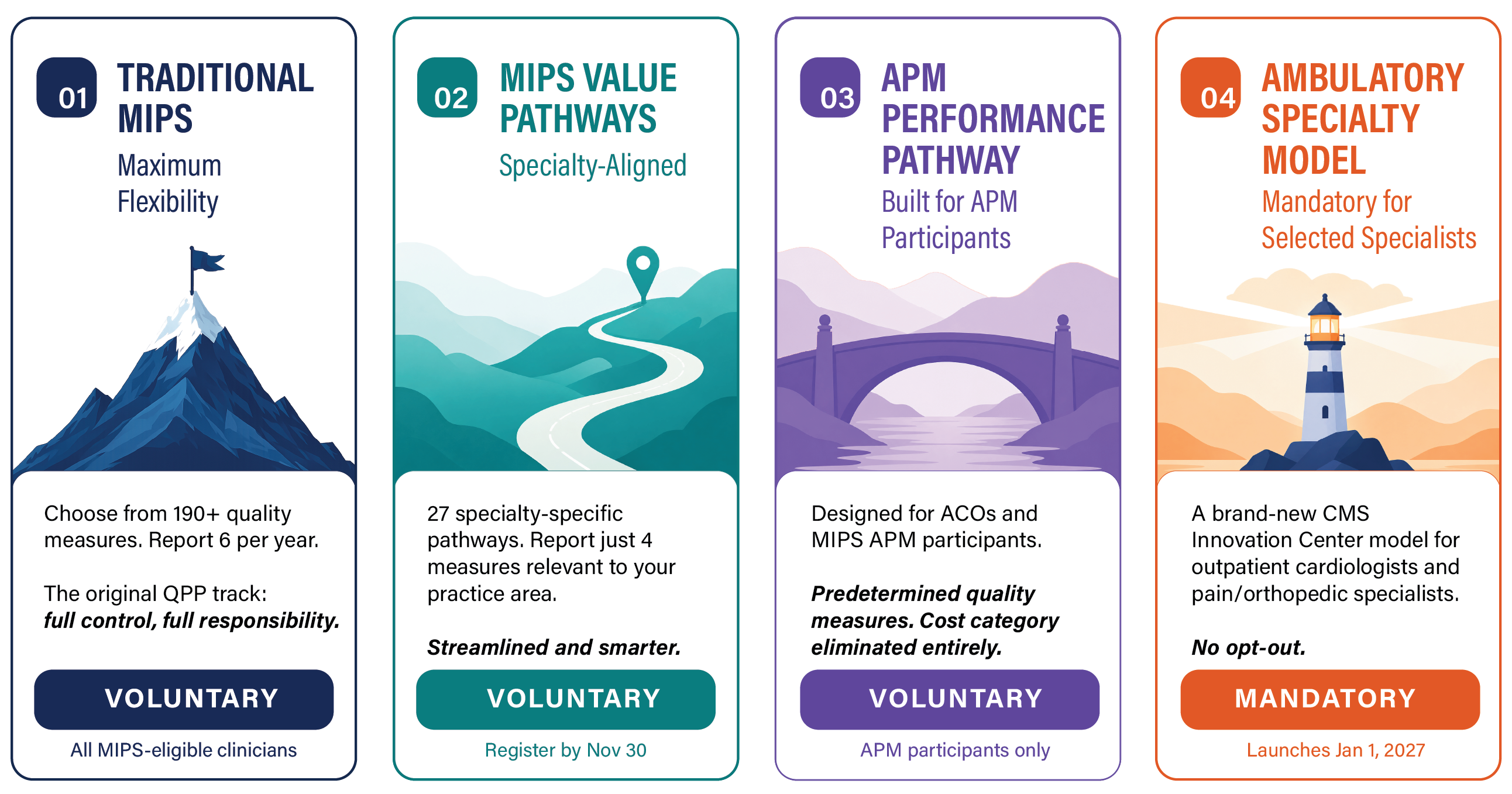
1. Traditional MIPS
The OG. Maximum Flexibility. Maximum Lift.
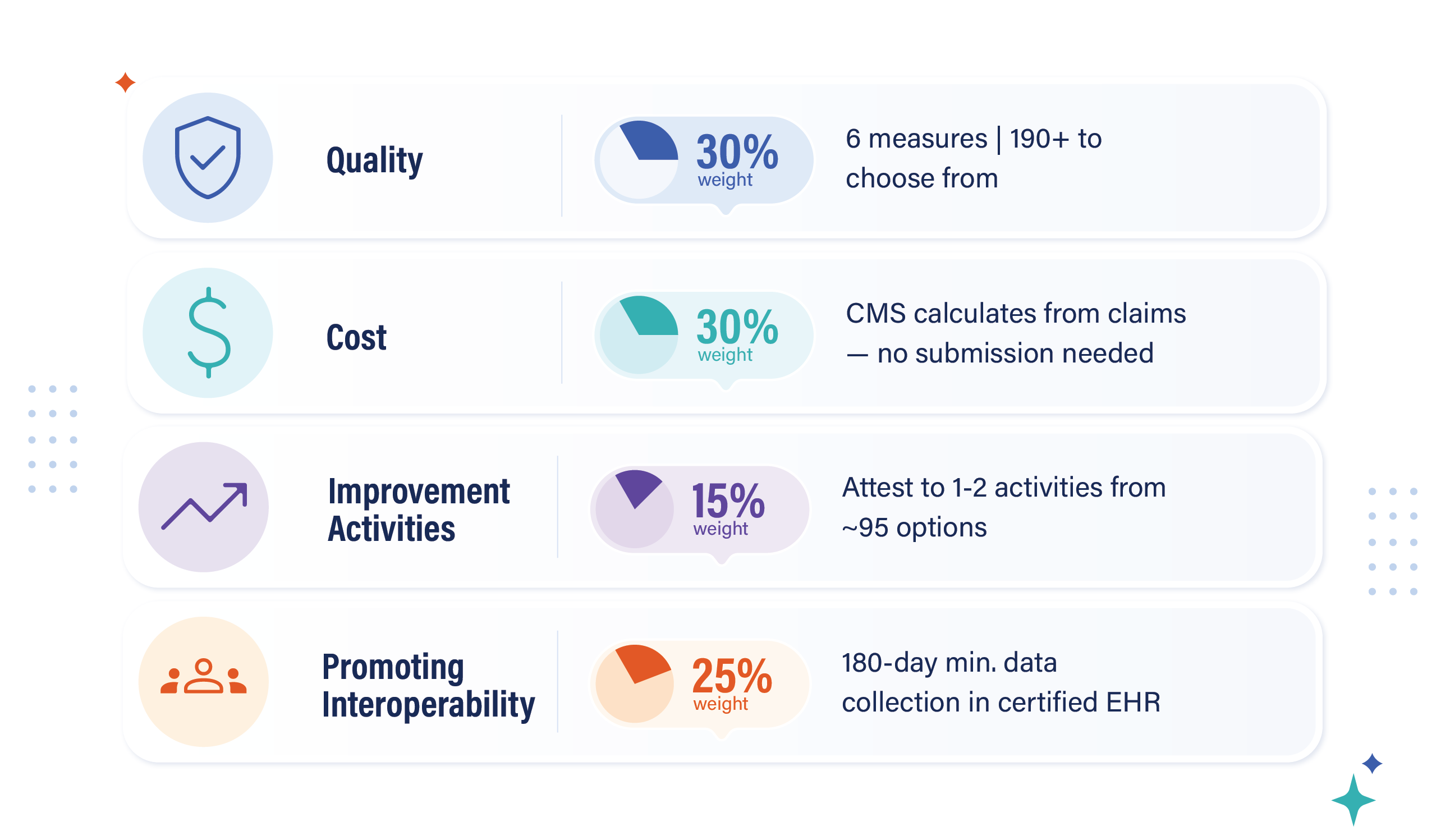
Traditional MIPS is the original reporting framework — and for good reason. It is still the most widely used. You pick your measures, you pick your activities, and you own your score. But that freedom comes with complexity.
You must report 6 quality measures over the full calendar year, at least one of which must be an outcome measure. Your measures are benchmarked against national performance data from 2024. Score at or above the 75-point threshold and you are in the green. Fall below and you are subject to a negative payment adjustment.
 |
Best fit for: Large or multi-specialty practices with robust data infrastructure and the bandwidth to optimize measure selection year over year. |
2. MIPS Value Pathways (MVPs)
Specialty-Aligned. Less Noise, More Signal.
MVPs were built on a simple insight: a cardiologist and a dermatologist should not be picking quality measures from the same 190-item list. Each MVP bundles the measures and activities most relevant to a clinical specialty or condition into a single cohesive pathway.
In 2026, 27 MVPs are available — covering everything from cardiology and oncology to podiatry and neuropsychology. Instead of 6 measures, you report just 4 specialty measures. You also get enhanced comparative feedback: your performance benchmarked against other clinicians in the same pathway, not the entire MIPS universe.
New in 2026: Multispecialty groups with 15+ clinicians can no longer report MVPs as a single group. They must form subgroups — subsets of clinicians within the same TIN who share a clinical focus.
The MVP foundational layer is the same for every pathway — the full Promoting Interoperability measure set plus two population health measures (hospital-wide readmissions and chronic condition admission rates) that CMS calculates automatically from claims.
- Quality: 4 measures (down from 6) — all from your selected MVP's list
- Improvement Activities: Just 1 activity, and every MVP participant earns full credit (40/40)
- Cost: Only the cost measures included in your chosen MVP are scored
- PI: Identical to Traditional MIPS — same measures, same rules
|
Best fit for: Single-specialty practices or specialty-focused service lines looking to reduce reporting burden while gaining more clinically meaningful feedback. |
3. APM Performance Pathway (APM)
If You’re in an ACO, This is Your Lane.
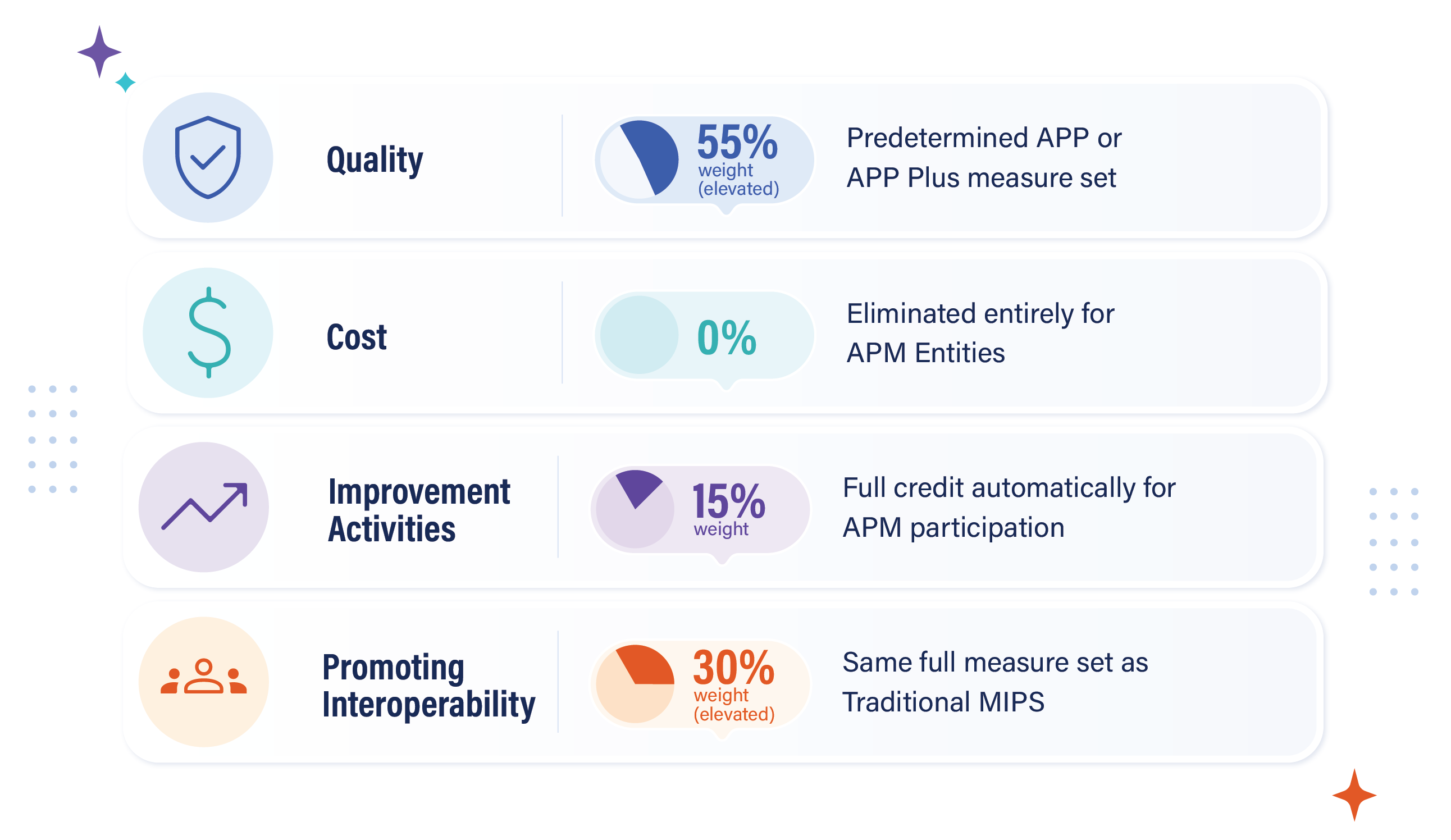
The APM Performance Pathway exists because clinicians in Alternative Payment Models — like Medicare Shared Savings Program ACOs — are already being held accountable for cost and quality through their APM agreement. The APP streamlines their MIPS reporting accordingly.
Under the APP, quality measures are predetermined — no shopping required. MSSP ACOs must use the APP Plus measure set for 2026. The cost performance category is eliminated entirely (APM participants are already accountable for spending through their model). And improvement activities? Automatic full credit just for participating in an APM.
|
Best fit for: Physicians and practice groups participating in MSSP ACOs, or other CMS-recognized MIPS APMs who want reduced reporting complexity. |
4. Ambulatory Specialty Model (ASM)
Mandatory for Outpatient Specialists. No Opt-Out.
ASM is fundamentally different from everything above. It is not a MIPS reporting option — it is a mandatory CMS Innovation Center alternative payment model. If you are an identified cardiologist or low back pain specialist in a targeted geographic area, you will be required to participate starting January 1, 2027.
ASM targets two clinical cohorts — heart failure and low back pain — and holds specialists accountable for chronic disease management, upstream prevention, and care coordination with primary care. The quality measure sets are fixed (5 per cohort) and the improvement activities are mandated, not chosen.
ASM participants are exempt from MIPS entirely during ASM performance years — they cannot participate in MIPS or receive a MIPS payment adjustment while in ASM.
-
Quality: 5 fixed measures per cohort — no selection, no flexibility
-
Cost: Episode-based measures — same measures used to determine your eligibility
-
Improvement Activities: Two mandatory activities focused on primary care coordination and social needs screening
-
Promoting Interoperability: Mirrors MIPS requirements; same CEHRT rules apply
-
Payment range: -9% to +9% (growing in later years) — not budget-neutral like MIPS
|
Is ASM on your radar? CMS has released a preliminary participant list. Check the ASM Participants dataset at the CMS Innovation Center website to see if a physician at your practice is identified for the 2027 performance year. |
The Shared Foundation Across Frameworks
Despite how different these frameworks look on the surface, they run on the same underlying infrastructure. That’s good news. It means you’re not starting from scratch every time you evaluate a new path. The core mechanics stay consistent.
Here’s what carries across all four:
- The same four performance categories: Quality, Cost, Improvement Activities, and Promoting Interoperability remain the foundation of every framework.
- The same Promoting Interoperability requirements: The measures and CEHRT requirements don’t change, so your EHR workflows transfer across frameworks.
- The same quality benchmarks: A measure scored in an MVP is benchmarked the same way as it would be in Traditional MIPS. Except for ASM.
- The same submission process: All data is submitted through the QPP portal (qpp.cms.gov), regardless of framework.
- The same small practice accommodations: Practices with 15 or fewer clinicians receive consistent support, including PI reweighting and simplified Improvement Activities.
- The same performance threshold: The bar remains 75 points for a neutral payment adjustment. Except for ASM.
Choosing the Right Framework
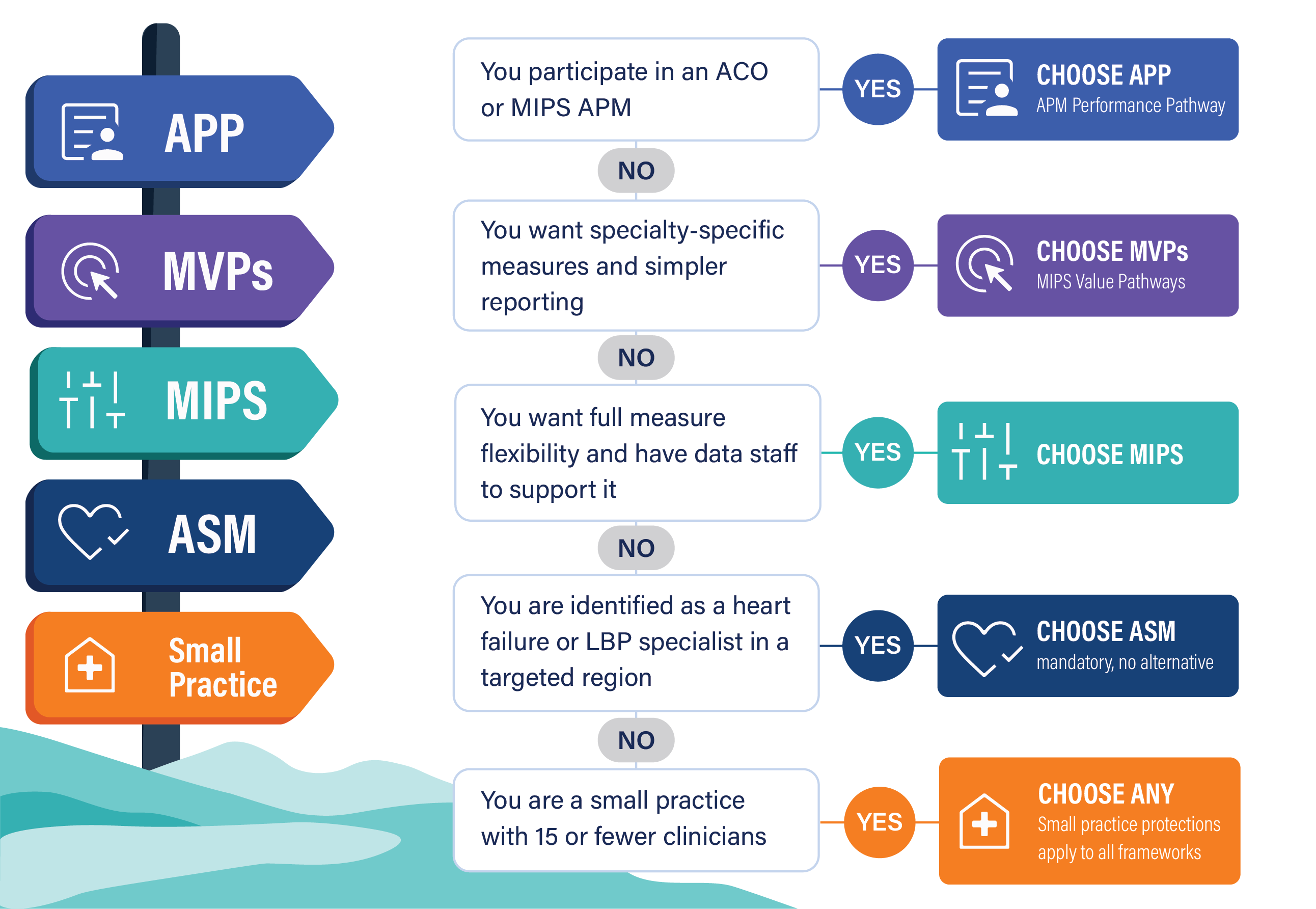
The Bottom Line
The 2026 performance year is already underway. The framework you choose now shapes your workload, your visibility into performance, and ultimately your 2028 payment adjustment.
The question isn’t whether you’ll report. It’s whether you’re reporting in the framework that actually works for your practice.
|
Built For The Framework You Choose Choosing the right QPP framework is only half the battle. Executing on it is where most organizations struggle. Each path comes with different requirements and performance pressures. Whether you're reporting through Traditional MIPS, MVPs, or the APP as part of an ACO, success depends on having clear visibility into your data and confidence in your performance. Medisolv’s QPP reporting packages are designed to support the way you report:
As expectations evolve, real-time visibility and early insight are essential. Medisolv helps you stay ahead of requirements and focus on improvement. Request a demo to see how Medisolv supports each QPP pathway and which approach is right for you. |
.png?width=352&name=2026%20Quality%20Reporting%20Deadlines%20Guide%20(1).png)

Comments