
CMS has released the preview reports for the April 2026 Overall Hospital Quality Star Rating, and this year brings both significant methodology changes and a notable upward shift in hospital performance. A total of 3,203 hospitals received a star rating, up from 2,891 in July 2025. Here’s what you need to know.
What Changed in 2026
Before we look at the results, it’s worth understanding the key methodology updates CMS made this year. The total measure count jumped from 46 to 52, driven by several notable additions and changes:
- Hybrid measures debut. For the first time, CMS incorporated Hybrid Hospital-Wide Mortality (HWM) into the Mortality category and replaced the former claims-only Hospital-Wide Readmission measure with Hybrid Hospital-Wide Readmission (HWR). However, for this rating period, only the claims component was used – meaning next year’s rating will incorporate actual EHR data from your hybrid measure submissions.
- HCAHPS scoring overhaul. All HCAHPS measures now use linear mean scores (a 0-100 scale) instead of the previous star rating format. Two combination measures were split: Cleanliness and Quietness are now separate measures, and Hospital Rating and Willingness to Recommend are now separate measures. This brings the HCAHPS count from 8 to 10.
- OAS CAHPS added. CMS added five Outpatient and Ambulatory Surgery CAHPS measures to the Patient Experience category, making it the largest group with 15 total measures.
- New Safety of Care cap. This is the change with the most consequences for the long term. If a hospital’s Safety of Care measure group score falls in the bottom 25% nationally and the hospital reports at least three safety measures, its star rating is capped at 4 stars. For 2027, CMS will change it to a one-star reduction regardless of current rating.
- Removed measures. CMS retired HCP-COVID-19 (Healthcare Personnel Vaccination) and PC-01 (Elective Delivery). The new maternal eCQMs (PC-02 and PC-07) were not included due to data issues with 2024 submissions.
- Two-year performance forecasts based on current measure trajectories
- Goal achievement calculator – set your target rating, and the tool calculates the exact measure performance rates you need to hit
- Strategic prioritization matrix – score measures across feasibility, population impact, and strategic value to know where to focus first
- Trending analytics against national benchmarks with peer hospital comparisons
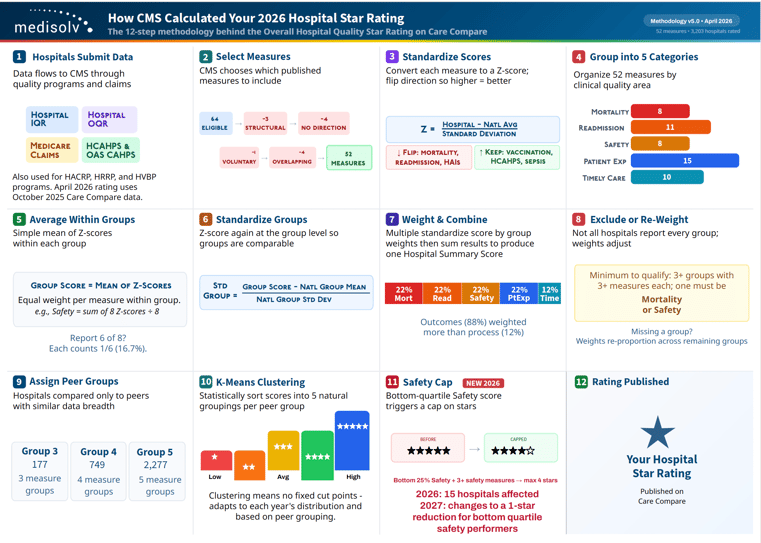
For a visual overview of the complete 12-step calculation methodology, download our infographic (PDF).
How Did Hospitals Perform?
The April 2026 distribution shows a clear upward shift in hospital performance:
|
Stars |
2025 |
2026 |
Change |
|
1 Star |
233 (8.1%) |
204 (6.4%) |
-29 fewer |
|
2 Stars |
663 (22.9%) |
670 (20.9%) |
+7 more |
|
3 Stars |
942 (32.6%) |
991 (30.9%) |
+49 more |
|
4 Stars |
762 (26.4%) |
953 (29.8%) |
+191 more |
|
5 Stars |
291 (10.1%) |
385 (12.0%) |
+94 more |
|
Total |
2,891 |
3,203 |
+312 |
Key Insights
The distribution shifted upward significantly. The share of 4- and 5-star hospitals grew from 36.4% to 41.8%. The 4-star category saw the largest increase of any rating level, jumping from 26.4% to 29.8% of all rated hospitals.
Fewer 1-star hospitals. Both the count (233 to 204) and the share (8.1% to 6.4%) of 1-star hospitals dropped, even though 312 more hospitals received ratings overall.
312 more hospitals received ratings. The total jumped from 2,891 to 3,203. Most of the growth landed in the 4-star (+191) and 5-star (+94) categories.
The new Safety of Care cap had a limited impact. Only 15 hospitals were affected by the new rule. None of those were 5-star hospitals, so the cap did not reduce any hospital’s published rating from 5 stars. However, this will become a bigger factor in 2027 when the rule changes from a cap to a one-star deduction.
Understanding the Full Calculation
The star rating methodology involves 12 distinct steps, from data submission through k-means clustering and the new safety cap. A detailed walkthrough of each step, with examples and formulas, is available on the Medisolv Quality Academy. Current Medisolv clients can access the full calculation review article through their Quality Academy portal.
What You Can Do Now
Assess Your Current Performance – Free
We just launched a free Star Rating Assessment Tool at https://www.hospitalstarratings.com/
Upload your Hospital Specific Report (HSR) from CMS and get an instant breakdown of your star rating calculation, measure-by-measure analysis across all five groups, and identification of your underperforming measures. It’s free, it’s fast, and it’s available to every hospital.
Go Deeper with the Hospital Star Rating Analyzer
We also launched the Hospital Star Rating Analyzer within our QualityIQ platform. This goes far beyond current-state analysis. The module gives you:
- Two-year performance forecasts based on current measure trajectories
- Goal achievement calculator – set your target rating, and the tool calculates the exact measure performance rates you need to hit
- Strategic prioritization matrix – score measures across feasibility, population impact, and strategic value to know where to focus first
- Trending analytics against national benchmarks with peer hospital comparisons
Instead of scrambling when ratings drop, you’ll have a roadmap showing exactly how to improve.
See it in action: Watch the demo on-demand here.
Learn How the Calculation Works – Webinar for Clients
Current Medisolv clients are invited to watch our 2026 Star Ratings Webinar on-demand, where we’ll walk through the data behind your hospital’s public reputation and how to interpret your results.
Watch the webinar on-demand here.
Get Expert Guidance with Advisory Services
If you want a hands-on partner to help improve your star rating, Medisolv’s Advisory Services team provides expert analysis of your Hospital Specific Report and a customized improvement strategy. Our clinical experts work with your team to identify the highest-impact opportunities and build a plan to move the needle.

.jpg?width=352&name=The%20Top%205%20Challenges%20in%20Manual%20Clinical%20Data%20Abstraction%20(And%20How%20AI%20Can%20Fix%20Them).jpg)

Comments