
AI in Healthcare: Innovation Still Needs Guardrails
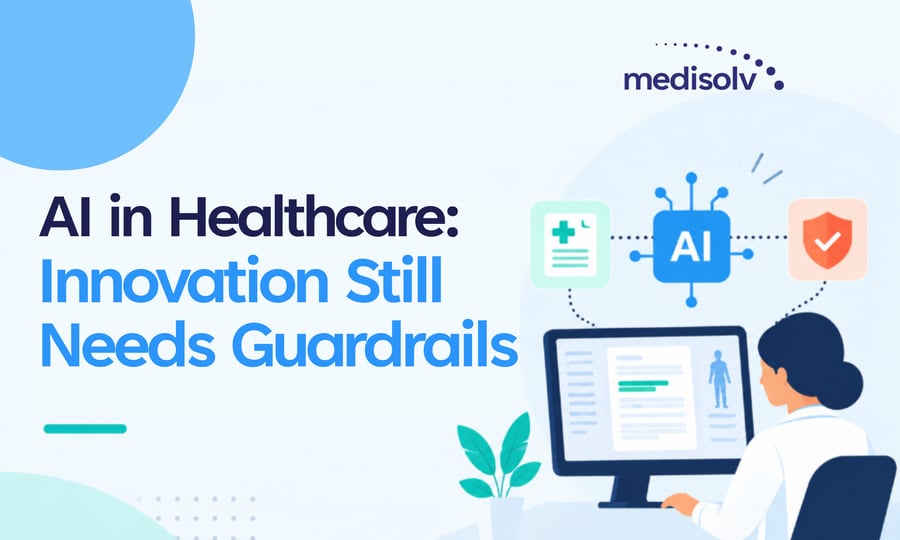
Artificial intelligence is creating enormous opportunities across healthcare.
It can help teams find information buried in clinical documentation, identify patterns across massive datasets, automate repetitive work and surface risks sooner. For healthcare organizations facing growing regulatory requirements, workforce constraints and more data than ever before, those capabilities matter.
But healthcare is also a perfect example of why AI can't be implemented the same way everywhere.
The more consequential the decision, the more important the guardrails.
Not Every AI Use Case Carries the Same Risk
There is a big difference between using AI to help an abstractor locate relevant clinical documentation and allowing AI to independently make a decision that affects a patient's care.
The technology may be similar. The consequences are not.
That's why healthcare organizations should think about AI adoption based on the risk associated with the task.
For lower-risk applications, AI can dramatically reduce manual work and help people get to the information they need faster.
As the potential impact increases, so should requirements for human oversight, validation, transparency and accountability.
Some simple questions can help frame that discussion:
- Can users see the information behind an AI-generated result?
- Can the result be validated against the source data?
- Is there a clear process when the technology is uncertain?
- Does a qualified person remain responsible for consequential decisions?
- Can the organization understand what happened after the fact?
Healthcare doesn't need less innovation. It needs innovation organizations can trust.
Use AI to Extend Human Expertise
The most valuable applications of AI aren't necessarily the ones that remove people from the process.
They're the ones that allow people to spend less time searching, sorting and manually reviewing information, and more time applying their expertise.
Clinical data abstraction is a good example.
An abstractor may spend significant time combing through documentation to find the evidence needed for a measure or registry. AI can help surface the relevant information and point the user back to the source.
AI does more of the searching.
The expert still makes the judgment.
The same principle can apply across quality measurement, performance improvement, patient engagement and care gap closure.
Technology should help healthcare professionals see more and act sooner, without losing the human context required to make good decisions.
Trust Starts With the Data
AI can also make previously difficult-to-use healthcare data far more accessible, especially the enormous volume of information contained in unstructured clinical documentation.
But AI doesn't eliminate the need for trusted data.
Organizations still need to understand where information came from, how it was interpreted and whether the output is reliable enough for the intended use.
That's particularly important as healthcare moves beyond retrospective reporting.
The opportunity ahead is to use AI to help organizations identify risk earlier, understand what is driving performance and take action while the outcome can still change.
For quality leaders, that might mean identifying a performance issue before the reporting period closes.
For a health plan, it could mean finding members who need additional outreach before a care gap remains open.
For an abstraction team, it may mean dramatically reducing the time required to find the right information within a patient record.
In each case, AI is a means to an outcome, not the outcome itself.
Moving Faster, Responsibly
Healthcare organizations don't have to choose between AI innovation and responsible AI.
They need both.
That means moving quickly where AI can reduce burden and improve access to information, while applying stronger oversight as the consequences of a decision increase.
At Medisolv, we believe the most meaningful applications of AI help healthcare teams trust the data, see risk earlier and act in time, while keeping human expertise where it matters most.
For a broader perspective on balancing AI innovation and guardrails across the healthcare industry, read Marc Ryan's original analysis on Healthcare Labyrinth: AI in Healthcare: Innovate, But With Guardrails.
Put AI to work where your teams need it most
Medisolv is bringing AI and automation directly into the quality workflows your teams already manage. Less searching. Less chasing. Less manual work.
Explore our AI solutions

Comments